Celebrity endorsements used to comprise the largest portion of a brand’s advertisement costs, and there was a time it seemed as if every major retailer had a celebrity representing “the face of the company”. These endorsements would last for the season or even over the course of a few years, and did well to reflect and refine what type of consumer each brand was marketing towards. Notable past celebrity endorsements include Madonna for Dolce & Gabbana (2009-2010), Angelina Jolie for St. John Knits (2005-2010) and Drew Barrymore for Gucci (2007).


Even today, this concept is as relevant as ever with Coach signing Selena Gomez on in an attempt to market towards millennials and an overall younger target demographic. [1] Celebrity endorsements were thought to increase sales as a result of that celebrity’s popularity, whether a purchase was made because the consumer loves that celebrity or because they love the way that celebrity dresses.

While this strategy was and has been successful for many years, retailers today are finding that many consumers are no longer basing their purchase decisions on famous faces. Most consumers will agree that while they can appreciate a beautiful face carrying a beautiful product, these celebrities are portraying picture-perfect lives that seem just too unattainable. As much as every college student would love to dress like their favorite celebrity, the harsh reality is that most of us cannot afford to do so. For high school and college women especially, our budgets are simply not designed to frequent designer labels.

Consumers became frustrated and began looking to new sources for styling inspiration. The launch of Instagram in 2010 played an especially integral part in the development of social media as an advertising platform for the retail industry due to its emphasis on visuals and graphic design. [2] As technology advanced, more and more “everyday people” began utilizing social media platforms such as Instagram to share styling ideas and quickly became known as bloggers. Consumers more readily trust these online bloggers because they come across as “real people” that are easily relatable and whose looks seemed easily attainable. Compared to famous beauty bloggers that use expensive, hard to find products for example, consumers today are more interested in seeing beauty enthusiasts share their thoughts on drugstore brands that are both cost effective and easy to find.
These bloggers have created a new kind of celebrity, described by terms such as “instafamous” and “product influencers”. Boasting millions of followers on various social media platforms, these bloggers use their online popularity to create ads for products and services. Technology has even advanced so far as to letting us “shop the post” on Instagram, and find links to purchase items straight from an Instagram post regardless of whether that company had even paid the blogger to advertise the product.
Today, brands are investing more than a billion dollars per year on Instagram-related advertisements. By having “everyday people” endorsing their products, consumers adopt the mindset that “if they can have it all, so can I”. These bloggers are sponsored by big brands (ex. Nordstrom’s “digital girls” are nicknamed “Nordie Girls”), and have become equivocated to the modern day billboard. [4]
Companies are “paying” for space on that person’s profile in order to increase brand exposure and extend their audience reach. In an article from the January 2015 edition of the New York Times, PR managers admitted that “digital girls” consistently spark higher conversion rates than celebrity advertisements, meaning they more successfully convert web visits into direct sales than celebrity product placement. [3]
Due to the increasing popularity of #ootd posts, many brands are finding that they no longer need to curate content for their Instagram pages; so many of their customers are creating diversified content for them everyday that brands have a multitude of options to choose from and repost. As the pool of online bloggers increases exponentially each day, companies are becoming smarter- PR departments are finding that they can drastically reduce advertising costs by utilizing these bloggers as product influencers. The only cost incurred by the company is the cost of sending these influencers the products the company wants advertised, with some companies even cutting costs altogether by reposting Instagram posts without compensation. [4]
This method of utilizing user-generated content for advertising has proved to be very effective for the retail industry. Not only does reposting a customer’s photo create a personal and loyal bond between the brand and that consumer, but reposted photos give new, potential customers a sense of security as well. Rather than browsing through professional photos of models and wondering how garments would really look once they arrived in the mail, seeing a variety of real women endorsing products makes potential customers more willing to place an order. Tracey Manner, the PR manager of the popular handbag line Botkier, admitted “We see higher conversions- marketing jargon for converting web visits into sales- off those (bloggers) girls than we do with celebrity placement that we might have paid money for”. [3]

Compared to past advertising budgets that needed to account for celebrity endorsements, photographers, stylists, etc., companies are learning to save millions by having these bloggers do it all for them. With these online bloggers incurring all of the costs related to curating these posts, companies are beginning to utilize their newfound “free” means of advertising to their advantage. [4] While there is still a lot of uncharted territory in regards to how ethics play into the conversation, it’s interesting to see how future technological advances will further affect the fashion industry.
STYLING:
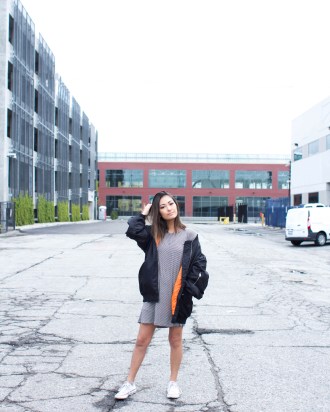
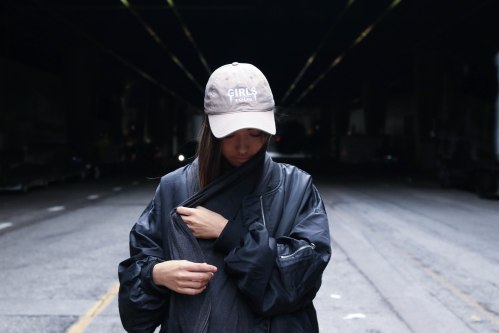
T-Shirt Dress by Brandy Melville , Oversized Bomber Jacket by Sorella Boutique , Infinity Scarf by Brandy Melville , Cap by Sorella Boutique
PHOTOGRAPHY:
ACADEMIC INSIGHTS:
[1] NY TIMES “Coach Confirms Its Partnership with Selena Gomez”
[2] DIGITALIST MAGAZINE “6 Reasons Instagram Essential to Fashion and Fitness Brands”
 Lieutalica. by Tiffanie Sayaka
Hi – insightful read and a definite trend that is observable as social media platforms emerge and develop new revenue strategies.
LikeLiked by 1 person
thank you so much for your positive feedback! much appreciated ❤
LikeLike